
Radio Frequency (RF) Basics #
Just got me a HackRF One and I’m diving into the world of radio frequencies (RF) communication. This post serves as a primer on RF concepts, particularly in the context of satellite communication.
What is RF? #
Radio Frequency (RF) refers to the electromagnetic waves in the frequency range of 3 kHz to 300 GHz.
RF are used to transmit information wirelessly over distances. They can travel through air and vacuum. It is used for radio, television, wifi, and satellite communication for example.
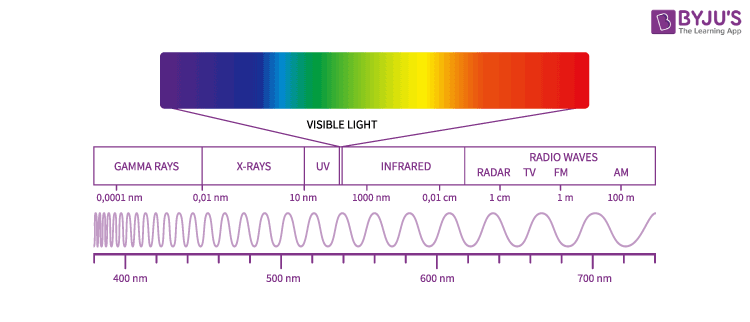
Source: Byjus - Electromagnetic Spectrum
We are later going to explore the latter, as it is a key component of modern communication systems, enabling the transmission of data over long distances without the need for physical connections.
As they are photons, RF waves travel at the speed of light (approximately 299,792 km/s in a vacuum). This means that RF signals can cover vast distances quickly, making them ideal for communication applications.
Note that even if radiofrequency is a radiation, it does not have enough energy to ionize atoms or molecules, which means it does not cause the same kind of damage as ionizing radiation (like X-rays or gamma rays).
Some definitions #
When talking about RF, there are some key terms and concepts to understand:
-
Frequency: The number of cycles per second of a wave, measured in Hertz (Hz). RF frequencies range from 3 kHz to 300 GHz.
-
Wavelength: The distance between two consecutive peaks of a wave, inversely related to frequency. It is calculated as the speed of light divided by the frequency (λ = c/f).
-
Sine Wave: A smooth, periodic oscillation that represents a single frequency. It is the basic waveform used in RF communication.
-
Amplitude: The height of the wave, representing the strength of the signal. In RF communication, amplitude can be modulated to carry information.
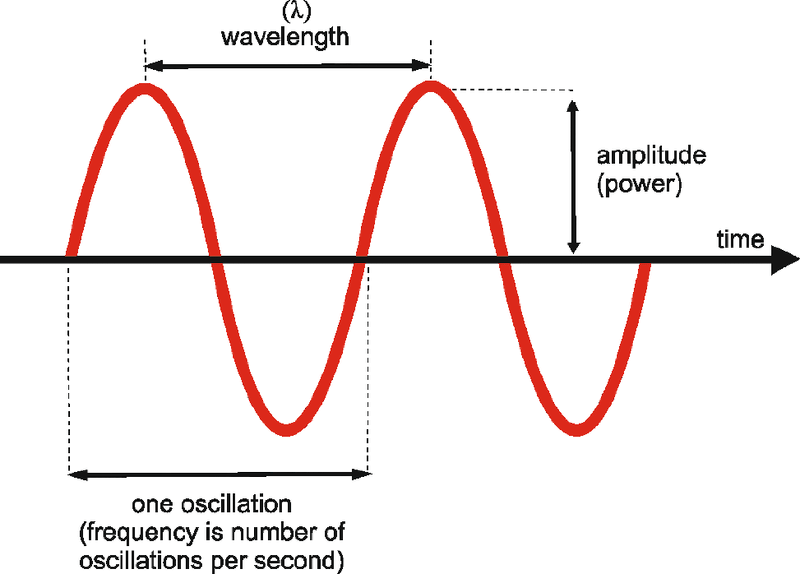
Using a carrier wave (usually a sine wave), we can encode information by “adding” another signal to it. This process is called modulation, and it allows us to transmit encoded information over RF waves.
RF Spectrum #
The RF spectrum is divided into several bands, each with its own frequency range and applications. Here are some common bands:
| Band Name | Abbreviation | ITU Band Number | Frequency | Wavelength | Example Uses |
|---|---|---|---|---|---|
| Extremely low frequency | ELF | 1 | 3–30 Hz | 100,000–10,000 km | Communication with submarines |
| Super low frequency | SLF | 2 | 30–300 Hz | 10,000–1,000 km | Communication with submarines |
| Ultra low frequency | ULF | 3 | 300–3,000 Hz | 1,000–100 km | Submarine communication, communication within mines |
| Very low frequency | VLF | 4 | 3–30 kHz | 100–10 km | Navigation, time signals, submarine communication, wireless heart rate monitors, geophysics |
| Low frequency | LF | 5 | 30–300 kHz | 10–1 km | Navigation, time signals, AM longwave broadcasting (Europe and Asia), RFID, amateur radio |
| Medium frequency | MF | 6 | 300–3,000 kHz | 1,000–100 m | AM (medium-wave) broadcasts, amateur radio, avalanche beacons |
| High frequency | HF | 7 | 3–30 MHz | 100–10 m | Shortwave broadcasts, CB radio, amateur radio, aviation communications, RFID, over-the-horizon radar, ALE/NVIS, marine and mobile radio telephony |
| Very high frequency | VHF | 8 | 30–300 MHz | 10–1 m | FM, TV broadcasts, aircraft communication, land/mobile/maritime comms, amateur radio, weather radio |
| Ultra high frequency | UHF | 9 | 300–3,000 MHz | 1–0.1 m | TV, microwave devices, radio astronomy, phones, WLAN, Bluetooth, ZigBee, GPS, 2-way radios, satellite radio, RC systems, ADS-B |
| Super high frequency | SHF | 10 | 3–30 GHz | 100–10 mm | Radio astronomy, microwave devices/comms, WLAN, DSRC, radar, comms satellites, cable/satellite TV, DBS, amateur & satellite radio |
| Extremely high frequency | EHF | 11 | 30–300 GHz | 10–1 mm | Radio astronomy, microwave relays, remote sensing, amateur radio, directed-energy weapons, millimeter wave scanners, WLAN (802.11ad) |
How it works ? #
Note that my explaination is simplified and does not cover all the details of RF communication, but it should give you a good understanding of the basic concepts.
Let’s send data ! #
RF are electromagnetic like we said earlier. Getting back into you science classe course, you might remember that electromagnetic waves are made of electric and magnetic fields oscillating perpendicular to each other and to the direction of propagation.
We call them electromagnetic waves because they are a close relationship between electricity and magnetism. When an electric current flows through a conductor, it generates a magnetic field around it.
With an alternating current (AC), at the correct frequency, we make the electrons oscillate back and forth, creating a magnetic field.
Imagine a rope. You transform your energy into a wave by shaking the rope up and down. The wave travels along the rope, carrying energy with it. In RF communication, we do something similar with electromagnetic waves.
“Roger, over and out” #
As we said again, electricity and magnetism are the expression of the same thing: electromagnetism. When the RF reaches the antenna, the electrons start to move, thus creating an alternating current that we can measure.
What about antennas then ? #
For the signal to be received correctly, the antenna must be tuned to the frequency of the RF signal. This is done by adjusting the length of the antenna to match the wavelength (or a fraction) of the signal.
It’s important to note that every antenna have gain dependingon its design. This means that some antennas are better at receiving signals from certain directions than others.
For example, a dipole antenna is omnidirectional, meaning it can receive signals from all directions equally. But it may be uneffective for deep space communication because it can pick up noise from all directions, making it harder to isolate the desired signal.
Directional antennas, like Yagi-Uda or parabolic dish antennas, are designed to focus the signal in a specific direction, increasing the gain and reducing interference from other directions.
Some physical concepts #
Low frequencies (LF) have longer wavelengths and can travel longer distances, but they are more susceptible to interference from obstacles like buildings and trees. High frequencies (HF) have shorter wavelengths and can carry more data, but they are limited in range and can be affected by atmospheric conditions.
As they are low frequencies signals, AM radio waves can travel long distances, even around the curvature of the Earth. This is because they can reflect off the ionosphere, a layer of charged particles in the upper atmosphere. During the night, solar winds pull out the ionosphere, allowing AM radio waves to travel even further. With the perfect conditions, you could receive AM radio signals from thousands of kilometers away.
Modulation #
Amplitude Modulation (AM) and Frequency Modulation (FM) are two common methods of modulating RF signals.
- AM: In AM, the amplitude of the carrier wave is varied in proportion to the message signal. This method is commonly used for AM radio broadcasting.
- FM: In FM, the frequency of the carrier wave is varied in proportion to the message signal. This method is commonly used for FM radio broadcasting and television audio.
Note: PM: Phase Modulation (PM) is a technique where the phase of the carrier wave is varied in accordance with the message signal. PM is often used in digital communication systems.
Knowledge application #
Let’s say I want to receive a signal from the International Space Station (ISS).
We need to know a few things:
- Frequency: The ISS transmits signals in the VHF band, specifically around 145.800 MHz for voice communication.
- Wave length: Calculated from the frequency.
- Location: The ISS orbits the Earth at an altitude of about 400 km, so we need to be able to receive signals from that height.
With the ISS value, wave length is about 2.07 m (calculated as c/f, where c is the speed of light and f is the frequency). This means that the antenna should measure 2.07 m or a fraction of it (like 1/4 or 1/2) to be tuned to the frequency of the ISS signal.
The modulation used by the ISS is typically FM for voice communication, which means that the frequency of the carrier wave is varied to carry the audio signal.